North Carolina State University Athletics
PEELER: Basketball's Biggest Influences
11/12/2009 12:00:00 AM | Men's Basketball
This story was originally published in "The Wolfpacker" and is reprinted here with permission from Coman Publishing Co.
BY TIM PEELER
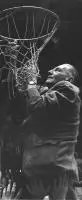
RALEIGH, N.C. - Let's get this straight: The most important person in the history of NC State and Atlantic Coast Conference basketball is Everett Norris Case, the Indiana-born coaching and marketing genius who brought big-time basketball to the south.
Case was innovative, crafty and devoted to the athletes he recruited - in fact, he left most of his considerable inheritance to his favorite players.
Reynolds Coliseum became a reality because of his immediate success, and Duke, North Carolina and Wake Forest became interested in basketball, out of sheer necessity, because Case beat them like a poorly executed zone press.
In his wake, North Carolina hired his rival Frank McGuire, Duke hired his assistant Vic Bubas and Wake Forest hired a former NC State player, Horace "Bones" McKinney, just to keep up with Case's success.
Case won his first basketball championship at the age of 16, while still enrolled at Anderson (Ind.) High School. He eventually became the first coach in the history of Indiana high school basketball to win the hotly contested state championship four times. In 1925, after winning his first title with the Frankfort (Ind.) Hot Dogs, he accepted the trophy from the inventor of basketball, James Naismith, the only coach in the history of Indiana basketball to do so.
He was at the forefront of recruiting, even in Indiana when such practices were not technically legal under high school rules.
He considered every game a feast, and he had a gargantuan appetite for success.
With his persuasion after winning six consecutive Southern Conference tournament titles, the newly formed ACC chose its basketball champion with an end-of-season tournament, at a time when every other "major" conference sent its regular-season champ. That ignited the passion for ACC basketball that has never been extinguished.
At the suggestion of a local sports editor, Case began the most successful holiday tournament in college basketball history, the Dixie Classic, played for 12 years between Christmas and New Year's at Reynolds Coliseum.
There is no way to overstate Case's importance in the growth of the game, from his heated rivalry with Bluegrass Baron Adolph Rupp of Kentucky to his showmanship that included spotlighted introductions, organ music throughout the games and summer basketball camps to keep interest going year-round.
He drove around the state in a booster-bought Cadillac, with a backboard and goal in the trunk. His goal was to see a hoop in every driveway in the state.
More than 90 years after Case won his first championship, that goal has been realized and exceeded.
However, throughout its century of basketball, NC State owes its rich tradition to a number of other influential people and organizations, from the YMCA to a famous sneaker salesman to the scads of coaches and players who brought success on the court.
Listed here are a handful of people, some of whom are familiar to modern fans, some of whom are completely unknown. But each was deeply influential to the development of NC State basketball.
THE ORIGINATOR: John W. Bergthold
One of the great things about being a pioneer is that every action or deed, no matter how small, is magnified by the long lens of history.
Such was the case of John W. Bergthold, a slight but energetic graduate of Oklahoma A&M College who arrived at the North Carolina School of the Agricultural and Mechanical Arts in September of 1908 as the general secretary of the campus chapter of the Young Men's Christian Association.
He is the all-but-unknown father of NC State basketball.
The campus YMCA – organized in 1889, shortly after the school welcomed its first class of students – was the center of student life in the early days of NC State. Bergthold was the second full-time general secretary, earning a salary of $630.30 during a time when tuition was $45 a year and room and board was $11 a year.
Described by the student newspaper, the Red and White, as a "young man of force who has his heart and soul in his work," Bergthold went about increasing the membership of the YMCA. Within a year of his arrival, it had nearly doubled from 125 to 243 of the 450 students enrolled at the school.
Though only 25 when he arrived, the Minnesota native and son of a Mennonite minister made important friends pretty quickly. The first speaker at one of his weekly meetings was Gov. Robert Broadnax Glenn. Josephus Daniels was also a frequent visitor and speaker. Two years after he arrived, the school received a $20,000 commitment from John D. Rockefeller for construction of its own YMCA building; as long as it could raise a similar amount. The state legislature kicked in another $10,000 and Bergthold kicked off a campaign to raise the remaining funds.
That building, completed in 1912 near Holladay Hall, included the school's first gymnasium and swimming pool. (It was demolished in 1975 to make way for the College of Design.)
Campus diversions were a big necessity. Hazing had become so bad in 1908 that Glenn threatened to cut off legislative funds to the school if it didn't cease immediately. At the time, there were only two varsity sports, football in the fall and baseball in the spring. In the December, 1908, edition of the Red and White, there was the first written mention of a new game on campus.
"Basket-ball has recently become one of the features of the YMCA, and although very few of the boys know how the game, they are taking much interest in it," the newspaper reported. "A team of Reds and another of Blues is going to be formed to oppose each other. After class foot-ball is over more interest will be taken in this."
Bergthold, however, remembered years later that there was some resistance to starting a new sport on campus.
"Many students and faculty members at first considered basketball a girl's game, because Meredith [College] played it," Bergthold wrote in a 1939 edition of the NC State Alumni News.
The original basketball teams were formed by class, to play for an early version of an intramural championship pennant.
"We inveigled a half-dozen innocents to go out on the old drill field and there, with some temporary goal posts, practiced throwing baskets and laying the foundation of basketball which has become such a factor in the sports of the college," Bergthold recalled.
From those teams, seven players were chosen to represent the school in a 1909 game against the Charlotte YMCA. But practice was hard. With no indoor gymnasium, the students practiced on the outdoor courts in an open field of what is now Pullen Park. The first varsity game was supposed to be played against Virginia Tech in Norfolk, Va., on Thanksgiving weekend 1910, but it was cancelled due to bad weather.
Two games were then scheduled against nearby Wake Forest in the winter of 1911. The first game was played at Wake Forest's gym on Feb. 16, with the well-practiced Baptists taking a 33-6 win. Five days later, however, the teams met for a rematch on the upper floor of old Pullen Hall.
The floor was slick – there had been a dance the night before – and the Farmers gained traction by soaking the soles of their sneakers in kerosene. They jumped out to a 15-11 halftime lead and held on for a 19-18 victory in the first college basketball game ever played in Raleigh.
Some 550 people attended the game, and Bergthold reported that the team cleared enough money to buy uniforms for the next year. And thus began varsity basketball at NC State.
Bergthold, who was also business manager of the tennis club, turned the organization of the basketball team over two students Percy Bell Ferebee of Elizabeth City and Guy K. Bryan of Tampa, Fla.
He stayed on campus through 1914, long enough to marry the first of his three wives, before leaving for a similar post at Alabama Polytechnic Institution (now Auburn University). He traveled the world during his career, participating in the 1922 American Pilgrimage of Friendship to Europe. During his full life, he lived in Chicago, Tampa, West Virginia and Washington, D.C.
He retired in 1946 and settled in Black Mountain, N.C., where he founded the High Top Colony and became one of the state's first all-organic farmers. He died at the age of 73 on July 18, 1955, and is buried in a Buncombe County cemetery.
Bergthold said in his 1939 article that one of his favorite students during his time at NC was a football player named John Von Glahn, hero of the 1907 football championship and a striking figure on campus at the time.
In 1946, Von Glahn was the business manager of the athletics association who joined faculty athletics chairman Dr. H.A. Fisher on a trip to an Atlanta hotel to interview a basketball coach.
His name? Everett Case.
THE BUILDER: David Clark
David Clark (1877-1955) was the son of one of the south's most liberal judges, North Carolina Supreme Court Chief Justice Walter Clark. He is one of five Clark brothers who attended NC State, and his family's name is on the Clark Chemistry Laboratories and the Clark Hall, former home of NC State's Student Health Services.
After graduating from the North Carolina School of Agriculture and Mechanical Arts with three degrees in engineering (as well as an engineering degree from Cornell), the 21-year-old Clark opened his own textile mill in Gaston County. After it failed because of the bankers' panic of 1907, Clark founded the Southern Textile Association and began publishing the Southern Textile Bulletin, wielding considerable influence in his industry with his editorials.
He became an outspoken conservative businessman, adamantly opposed to child labor laws, a cause he twice fought all the way to the United States Supreme Court.
Clark served as the president of the Alumni Association and was a member of the Board of Trustees for the Consolidated University of North Carolina. He was responsible for turning the school's early print shop into University Graphics.
What's that got to do with NC State basketball? Clark was the most influential supporter of athletics in the school's history, contributing money to pay for facilities and handing out loosely defined grants to student-athletes through the Delaware Student's Loan Fund.
In the late 1930s, the former NC State football and baseball player insisted that the school needed to replace crumbling Thompson Gymnasium. He also suggested that the school build a multipurpose facility that could be used as a home for the ROTC programs, the farmers' meetings and basketball games.
In 1940, Clark purchased the first load of structural steel for an on-campus arena/armory and suggested the school make use of the Depression-era Works Progress Administration (WPA) to get the project started. When World War II broke out in Europe, Clark encouraged the school to begin the construction, even though there were no funds to proceed, so that the steel would not be recalled for war purposes.
It was Clark's idea to add a hockey rink and ice-making equipment to help generate income for the athletics department, an idea that ultimately failed because the humidity caused by the ice caused the ceiling tiles to dislodge and fall to the floor.
Clark also strongly suggested that university controller W.D. Carmichael to Greenwich, Conn., to visit Mrs. Charles Babcock, an heiress to the Reynolds tobacco fortune. Carrying a table-size model that he left in Mrs. Babcock's living room, Carmichael asked for some financial support for the project. Three weeks later Mrs. Babcock sent a telegram saying she and her husband would contribute $100,000 for the project, the same amount contributed by the state. She suggested, in turn, that the building should be named for her uncle, the familiar William Neal Reynolds.
That name still rings in the ears of NC State athletics. But the building itself would have never been built without Clark's ornery persistence and considerable influence.
THE OUTSIDER: Chuck Taylor
In 1922, at the request of then-NC State basketball coach Gus Tebell, this former professional basketball player was invited to come to Raleigh to conduct the first of the thousands of basketball clinics he conducted in during his lifetime.
Nervous and but hardly lacking in confidence, Taylor gave some rudimentary suggestions and taught a few drills to the small group of players who gathered for the clinic. He then taught similar clinics at high schools, YMCAs and colleges across the nation for the next 35 years.
By 1946, Taylor had become one of basketball's most influential figures. His name had been stamped on the ankle patch of Converse's high-top sneaker in 1923 and it was the most popular shoe in the world for basketball players. When NC State began looking for a replacement for departed coach Leroy Jay, News and Observer sports editor Dick Herbert suggested the committee seek a recommendation from Taylor.
Taylor did not mince words: "The best basketball coach in the country is a Lt. Commander in the Navy. His name is Everett Case."
THE RECRUIT: Ronnie Shavlik
Recruiting in the early days of the ACC ended on the eastern banks of the Mississippi River. There were a few players, here and there, from Chicago, but practically no one went west to recruit talent.
In fact, when assistant coach Vic Bubas suggested to Case that they go look at a highly touted high school forward from Denver, Colo., Case was resistant to the idea.
"I don't even know anyone in Denver," said Case, who needed bird-dog confirmation about any player he recruited.
But Bubas had read a newspaper account of how the 17-year-old high school player dominated the 1952 AAU national tournament, which was held in Denver. Playing against older and more experienced players, Shavlik was named the Most Promising Player.
Case won a long recruiting battle against Kentucky's Adolph Rupp, Oklahoma A&M's Hank Iba and UCLA's John Wooden to lure Shavlik to NC State.
"I hadn't really seen much of the South," Shavlik once told "The Wolfpacker." "I came down here and was impressed with the area. I also wanted to get away and do something on my own. It was nice here, there were a lot of ambitious ideas about the basketball program, and the people at State were top-notch."
Shavlik was tall and agile. He once scored 49 points and had 35 rebounds against Villanova, both school records at the time. He could easily keep up with his guards, John Magglio and Vic Molodet, leading the Wolfpack to three consecutive ACC Championships and two Dixie Classic titles.
He still owns NC State's career rebounding record with 1,598, exactly 552 more than second-place Tommy Burleson.
He was the ACC's first consensus All-American, and ever since his arrival, recruiting at NC State and across the ACC has been from coast-to-coast.
THE PIONEER: Al Heartley
NC State was the first ACC school to integrate athletics, welcoming Walter Holmes Jr. and Manuel Crockett to the varsity track team and Irwin Holmes to the tennis team in 1956. Irwin Holmes was not only the first African-American to earn a degree from NC State, he was also the first black athlete in the ACC to be named the captain of a varsity team.
Case had considered recruiting African-American basketball players, even sending representatives from NC State to New Bern to talk to future Naismith Memorial Basketball Hall of Famer Walt Bellamy. But that did not work out, and Bellamy eventually became a two-time All-America selection at Indiana.
It wasn't until a half-dozen years later that ACC basketball teams began integrating, starting with Maryland's Billy Jones for the 1965-66 season.
In the fall of 1967, a shy applied mathematics student named Al Heartley walked into the office of NC State basketball coach Norm Sloan and asked to try out for the freshman team. He had been a star player at segregated Johnston Central High School. And, unknown at the time to Sloan, he was the brother of Harvey Heartley, who was a well-known figure as an African-American coach at the time.
Sloan knew the importance of Al Heartley's request, knowing the time had come to integrate his program, just as Maryland, Duke and North Carolina had done. He told Heartley to keep an eye out for tryout announcements in the student newspaper.
When those tryouts began, assistant coach Sam Esposito called Sloan over to watch Heartley play. He was not only the best of the walk-on players, he was also running circles around the seven recruited freshmen.
Heartley made the freshman team and averaged eight points a game, even though he was playing out of position at forward. In high school, he had played point guard.
The next year, Heartley was elevated to the varsity team, becoming NC State's first African-American basketball player. At the same time, Sloan recruited Ed Leftwich to become the school's first black player to be offered an athletics scholarship.
In 1970, Heartley helped the team win the ACC Tournament championship and in 1971 he was named the winner of the Alumni Athletics Trophy as the school's top athlete, as voted by the students.
A short time later, Shelby's David Thompson decided to come to the school. In the eyes of many, the exceedingly shy Thompson did not have the demeanor to break the racial barrier on campus. But since Heartley's path was smooth
Heartley, who currently lives in Atlanta, still regularly attends basketball games.
THE ADMINISTRATOR: Willis Casey
Casey was a penny-pinching, chain-smoking, bourbon-drinking athletics director who made his mark as a championship swimming coach and as an assistant to predecessor Roy Clogston.
He took over as athletics director – after Sloan turned the job down when he learned that he would have to give up being basketball coach – when Clogston retired in 1969.
During Casey's tenure, he had a knack for hiring promising young coaches: Lou Holtz, Bo Rein, Dick Sheridan, Rollie Geiger, Don Easterling and Ray Tanner, just to name a few.
And, while his unwavering stubbornness and shallow pocketbook eventually pushed Sloan back to Florida, Case had the insight to hire a pair of young coaches who both left indelible imprints on NC State men's and women's basketball: Jim Valvano and Kay Yow.
Perhaps Casey's greatest legacy on the game came as the head of the NCAA's influential committee on men's basketball, replacing UCLA athletics director J.D. Morgan. After the Wolfpack beat Maryland in the 1974 ACC Championship game - leaving the Terrapins out of the NCAA Tournament - Casey helped push through legislation that expanded the NCAA Tournament to more than one representative per conference.
Morgan had always opposed expansion, one of the main reasons the John Wooden's Bruins managed to dominate college basketball for more than a decade.
Like the ideas Case had years before, Casey's input was influential on developing the expanded post-season college basketball tournament.
Or, as it is more popularly known, "March Madness."
You may contact Tim Peeler at tim_peeler@ncsu.edu.